
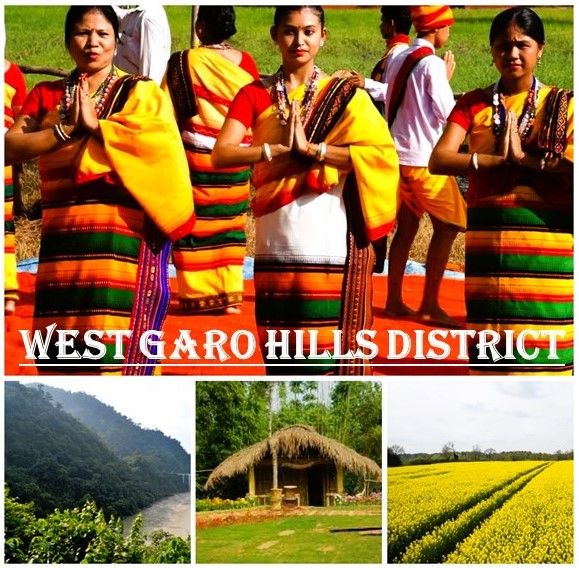
The West Garo Hills District of Meghalaya is a region of striking natural beauty, characterized by its hilly terrain, river systems, and rich biodiversity. Its geography plays a crucial role in shaping the lifestyle, economy, and culture of the people who inhabit this area.
Landforms and Mountain Ranges
The district is predominantly hilly, with plains fringing its northern, western, and south-western borders. The most prominent feature is the Tura Range, which stretches about 50 kilometers in an east-west direction from Tura to Siju in The South Garo Hills District. This range is home to several notable peaks, including Tura Peak, Nokrek Peak, Meminram Peak, Nengminjok Peak, and Chitmang Peak.
The highest point of the Tura Range is Nokrek Peak, rising to 1,412 meters, located about 13 kilometers southeast of Tura. To the west of the Tura Range, low hill ranges run north to south, while to the north, parallel ranges gradually increase in height until they converge in the south. These ranges are rich in flora and fauna, making them ecologically significant.
Climate
The climate of West Garo Hills is largely influenced by the South-West monsoon and seasonal winds. Being relatively lower in altitude compared to other parts of Meghalaya, the district experiences higher temperatures for much of the year. The average annual rainfall is about 330 cm, with more than two-thirds occurring during the monsoon season. Winters are practically dry, creating a distinct seasonal rhythm that impacts agriculture and daily life.
River Systems
The Tura Range serves as a watershed, giving rise to numerous rivers that flow towards the Bangladesh plains in the south and the Brahmaputra Valley in the north and west.
- Northern Rivers: The Kalu, Ringgi, and Didak are important rivers flowing northward.
- Southern Rivers: The Bhogai and Darrang are notable rivers flowing southward.
- Simsang (Someswari) River: The most significant river of the district, originating from the Nokrek Mountains. It is the largest and second-longest river in West Garo Hills. Locally known as Simsang, it flows eastward through Williamnagar, Nongalbibra, Siju, Rewak, and finally Baghmara.
The upper course of the Simsang is not navigable, but its lower course contains deep pools and waterfalls such as Mirik, Matma, Jamiseng, Warisik, Bobra, and Goka. Its chief tributaries include the Chibok, Rongdik, Rompa, and Ringdi rivers. These waterways are vital for irrigation, fishing, and sustaining the district’s biodiversity.
Forests and Natural Resources
West Garo Hills is covered mostly by dense tropical mixed forests, with patches of temperate forests in the higher elevations of the Tura Range. These forests are home to diverse species of plants and animals, contributing to the district’s ecological richness.
The region also possesses valuable mineral resources, including coal, limestone, phosphorus, gypsum, and glass sand. These resources have economic importance, though their extraction must be balanced with environmental conservation.
Conclusion
The Geography of West Garo Hills District is a blend of rugged hills, fertile plains, abundant rivers, and rich forests. Its natural features not only define the physical landscape but also influence the cultural and economic life of its people. From the towering Nokrek Peak to the flowing Simsang River, the district’s geography is both a source of sustenance and a symbol of its natural heritage.