
Introduction
“The Romanticists’ explanation of creativity convinced me so that the painterly skills seemed to me to be more in the realm of technique as in the case of craftsman and the creativity implied what a painter could be beyond this. That is why how a poet or literary person sees the world around him, gets involved with experiences of life and how they affect his emotions, are according to me the sort of situations that a ‘feeling person’ encounters, contributing to the making of the creatively endowed artist. Ratan Parimoo.
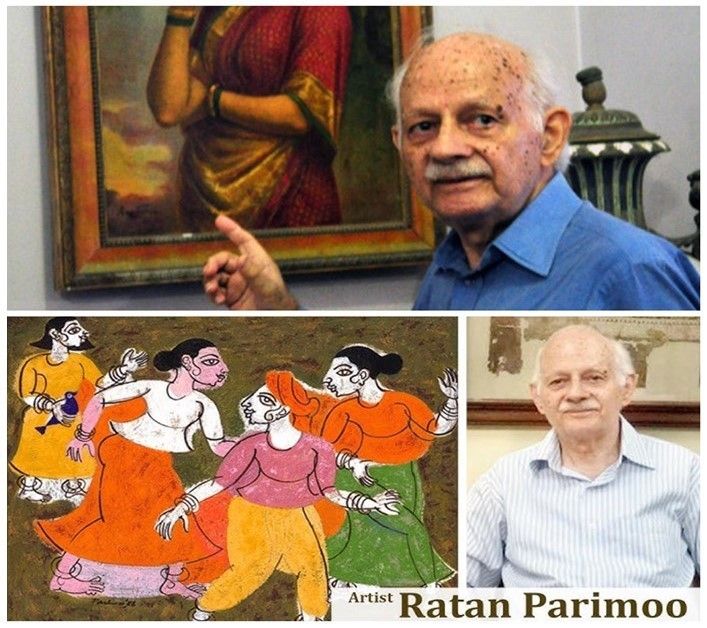
This profound reflection encapsulates the philosophy of Ratan Parimoo, one of modern India’s most distinguished art historians and painters. For Parimoo, creativity was not merely a matter of skill or technique; it was a deeper engagement with emotions, experiences, and imagination. His life and work embody this belief, weaving together scholarship and artistry in ways that resist easy categorization. Both his canvases and his writings reveal a restless, searching mind committed to exploring the many dimensions of art.
Early Life and Education
Born in 1936 in Srinagar, Kashmir, Ratan Parimoo’s artistic journey began at the Faculty of Fine Arts, M.S. University, Baroda. He graduated in Fine Arts in 1955, followed by an M.A. in Creative Painting and a Post Graduate Diploma in Museology in 1957. His intellectual curiosity led him to London University, where he earned a graduate degree in History of Art in 1963. Later, he completed his Ph.D. in Art History from M.S. University, Baroda in 1972.
Parimoo personal life was equally intertwined with art. He married Naina Dalal, herself an accomplished painter, and together they became a celebrated duo in the Indian art world. Their joint exhibitions and collaborations enriched India’s cultural landscape, blending individual creativity with shared vision.
Academic Career and Leadership
Parimoo Association with M.S. University, Baroda, spanned decades and shaped generations of artists and scholars. Beginning as a Lecturer in Art History in 1959, he rose to become Reader and Head of the Department of Art History and Aesthetics in 1966, and later served as Professor until 1978. His leadership culminated in his tenure as Dean of the Faculty of Fine Arts from 1975 to 1981.
Beyond Baroda, Parimoo played influential roles in national institutions. He served on the Executive Board of Lalit Kala Akademi, Delhi (1981–84), as Executive Secretary of the Indian Association of Art Historians (1982–88), and as a member of UGC panels on Art History and Museology. He also contributed to the Central Advisory Board of Museums, Government of India, and committees of the National Gallery of Modern Art (NGMA). These positions highlight his dual identity as both teacher and policymaker, ensuring that scholarship and creativity were nurtured side by side.
Exhibitions and Artistic Journey
Parimoo’s creative journey was marked by numerous solo and group exhibitions across India and abroad. His first one-man show was held in Srinagar in 1958. Retrospectives followed at Rabindra Bhavan, Delhi (1972), Jehangir Art Gallery, Mumbai (1999), and Cymroza Art Gallery, Mumbai (1999). Internationally, he exhibited at Durham, U.K., in 1962.
He participated in national exhibitions organized by Lalit Kala Akademi, Baroda Group of Artists exhibitions in Bombay, and collaborative shows with Naina Dalal. His works were also featured in thematic exhibitions such as Artists Against Communalism(1991–92), Tribute to Husain(1995), and Major Trends in Indian Art(1997). These exhibitions reveal his versatility and his commitment to engaging with contemporary social and cultural issues.
Notable Works
Parimoo’s oeuvre spans a wide range of themes and techniques. Some of his notable works include:
- Woman with Matka (oil on board)
- Habba Kadal (oil on board, 1957)
- Lotus Valley (digital print, original oil on board)
- Marriage Procession (oil on canvas)
- Still Life with Kashmiri Objects (oil on canvas)
- Kingdom of Cards (oil on canvas)
- Self Portrait as Icarus Transformed (oil on canvas)
- Sea of Eyes (oil on canvas)
- Dance of Death II (oil on canvas)
- Mahishasuramardini (oil on canvas)
- Encounter with Nothingness (oil on canvas)
These works reveal his ability to move fluidly between figurative and abstract, mythological and contemporary, personal introspection and social commentary. His experimentation with media oil, sand, encaustic demonstrates his ceaseless creativity and refusal to be confined by convention.
Recognition and Awards
Parimoo’s talent and scholarship earned him numerous accolades:
- Cultural Scholarship for Painting, Government of India (1957–59)
- Commonwealth Scholarship to study in London (1960–63)
- First Prize in Painting, Annual Exhibition, J & K Cultural Academy (1966)
- Rockefeller Grant to study and travel in the USA (1974)
- Jawaharlal Nehru Fellowship (1991–93)
These honors reflect both national and international recognition of his contributions to art and art history.
Contributions to Art History and Literature
Parimoo was not only a painter but also a prolific writer. His scholarship sought to evolve new directions in art historical studies. Some of his significant publications include:
- Paintings of the Three Tagores (1973)
- Studies in Modern Indian Art (1975)
- Life of Buddha in Indian Sculpture (1982)
- Sculptures of Sheshashayi Vishnu (1983)
- The Paintings of Rabindranath Tagore (1989)
- The Pictorial World of Gaganendranath Tagore (1995)
- Studies in Indian Sculpture (1999)
- Ceaseless Creativity: Paintings, Prints and Drawings (1999, edited by Gauri Parimoo Krishnan)
Through these works, Parimoo bridged classical and modern Indian art, offering insights into both traditional sculpture and contemporary painting. His writings remain essential references for scholars and students alike.
Legacy and Influence
Parimoo’s creations adorn prestigious institutions such as the Hermitage, Leningrad; National Gallery of Modern Art, New Delhi; Punjab University, Chandigarh; Air India, Mumbai; Gujarat State Lalit Kala Akademi, Ahmedabad; and Sahitya Kala Parishad, New Delhi. His dual identity as painter and historian makes him a unique figure in Indian art.
His legacy lies not only in his canvases but also in his students, writings, and institutional contributions. He demonstrated that creativity is not confined to technique but is deeply rooted in emotion, imagination, and intellectual inquiry.
Conclusion
Ratan Parimoo stands as a towering figure in modern Indian art. His paintings embody imagination and emotion, while his scholarship enriches the study of Indian art history. From his Kashmiri roots to his leadership at Baroda, from his canvases to his books, Parimoo’s journey reflects ceaseless creativity and dedication.
As both Painter and Historian, he reminds us that art is not merely about skill but about vision the ability to see the world through feeling, experience, and imagination. His contributions continue to inspire artists, scholars, and admirers, ensuring his place as one of India’s most distinguished cultural custodians.