
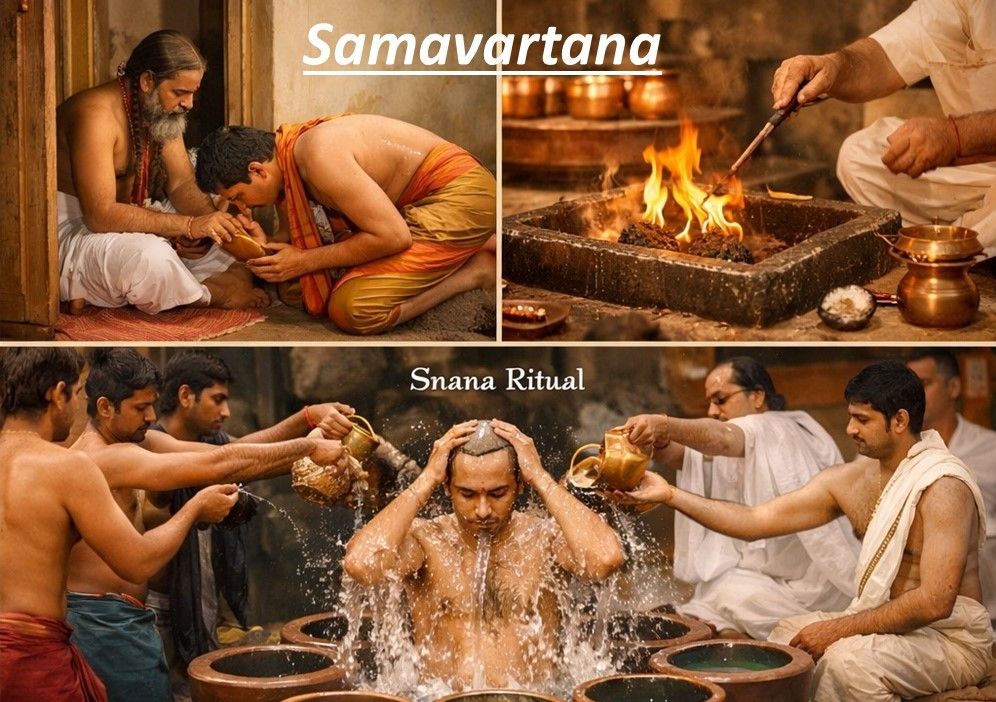
The Samavartana ceremony is one of the most profound rites of passage in Hindu tradition. It marks the completion of the student’s phase of Brahmacharyaand his readiness to enter Grihasthashram, the stage of household life. Often referred to as the Snana (bath) ceremony, it embodies purification, gratitude, and preparation for active participation in family and society.
Rituals of Samavartana
The ceremony unfolds with symbolic acts that highlight humility, discipline, and reverence:
- Bathing ritual: Eight Vessels of Water are arranged to represent the eight directions. The student bathes using one vessel, discards old garments, and dons new attire. Shaving, trimming nails, and cleansing teeth symbolize discipline and readiness for a more active life.
- Tribute to teacher: The student bows at his teacher’s feet and offers fuel to the sacred fire (Yajna), expressing gratitude for knowledge and tradition.
- Fragrant water bath: Bathing in scented water signifies refinement and social readiness.
- Introduction to scholars: The teacher presents the student before an assembly of learned individuals, where he earns the titles Vidyasnataka (bathed in learning) and Vratasnataka (bathed in vows).
Celebration of Samavartana
The celebratory aspect emphasizes hospitality, offerings, and community recognition:
- Madhuparka offering: A mixture of honey or ghee with curd is offered to the teacher, king, and relatives, symbolizing sweetness and prosperity.
- Yajna rituals: The Acharya performs sacred offerings such as Agharavajyabhagahuti, Vyahriti Ahutis, Svistakrit, Prajapatyal, and Ajahutis. The student participates by adding sticks to the fire while chanting mantras.
- Garland and gifts: Wearing a garland, the Brahmachari recites mantras and presents gifts—ranging from clothes to a cow—depending on his family’s means.
- Modern practice: Today, the ceremony is often simplified and combined with other rites such as Upanayana (sacred thread ceremony) or Vivaha (marriage), reflecting contemporary lifestyles.
Cultural Significance
The Samavartana ceremony is not merely ritualistic; it is a cultural milestone with deep philosophical meaning:
- Transition to adulthood: It marks the student’s shift from disciplined learning to responsibility and contribution.
- Respect for teachers: Gratitude toward the Acharya underscores the importance of mentorship in Hindu tradition.
- Integration into society: The student is formally recognized as ready to engage in intellectual and social life.
- Spiritual purification: The bath and offerings symbolize inner cleansing and readiness for marriage and family duties.
Conclusion
The Samavartana ceremony beautifully encapsulates the Hindu philosophy of life stages. It bridges the contemplative discipline of Brahmacharya with The Active Responsibilities of Grihasthashram. Though simplified in modern times, its essence purification, gratitude, and readiness for life’s next chapter remains timeless.
This rite of passage continues to remind us of the balance between learning, respect, and responsibility, making it a cornerstone of Hindu cultural tradition.