
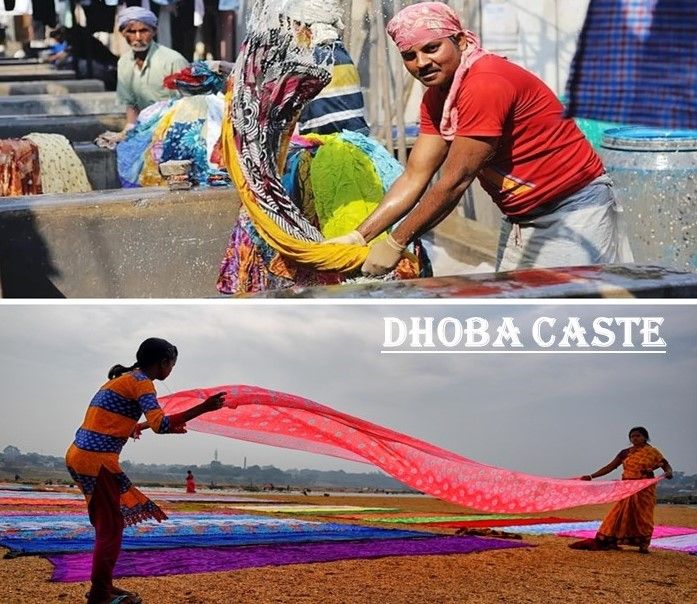
The Dhoba caste is a relatively small yet culturally significant community residing in the central regions of India. Despite their distinct identity, they have historically been grouped with the Dhobi caste in census records and have never been recognized as a separate category. The Dhoba community of the Mandla region, however, firmly denies any association with the Dhobis, emphasizing their unique lineage, traditions, and social practices that set them apart.
Physically, the Dhobas are described as tall, dark in complexion, and possessing flat features similar to those of the Gond tribe. Their origins remain somewhat obscure, but scholars suggest that they may be an offshoot of one of the Dravidian tribes. This theory explains their cultural similarities with other tribal groups in the region and highlights their deep-rooted connection to India’s indigenous heritage.
Exogamous Sects and Marriage Customs
The Dhoba Caste is divided into nearly twelve exogamous sects, many of which are named after villages. Marriage rules within the community are strictly enforced. For instance, unions are prohibited between members of the Maratha and Khatnagar sects, the Maralwati sect, the Baghmar and Baghcharia sects, and the Sonwani and Sonsonwani sects. These names often carry symbolic meanings: Baghmar and Baghchariaare derived from the tiger, while Sonwanioriginates from “Sona-pani” or gold-water.
Marriage customs are distinctive and reflect both tribal and Hindu influences. While children of a brother and sister may marry, the children of two sisters cannot. Weddings are conducted according to Hindu rituals, with the bridegroom traveling to the bride’s village. The ceremony involves the traditional practice of walking around a sanctified post. Divorce and widow remarriage are permitted, which demonstrates a degree of social flexibility not always found in other caste groups.
Birth and Funeral Rites
The Dhoba community observes elaborate birth and funeral rites. Unlike many Hindu groups that cremate their dead, the Dhobas bury them, followed by a series of funeral rituals. These practices emphasize their tribal roots and distinguish them from neighboring communities, while also reinforcing their cultural identity.
Leadership and Social Discipline
The caste head, known as the Raja, belongs to the Sonwani sect. He holds significant authority but does not have a deputy. Instead of receiving contributions from the caste, he is entitled to a double share of food and sweetmeats during communal distributions. The Raja also appoints committee members from any sect at his discretion, reinforcing his central role in community governance.
Disciplinary measures within the caste are unique and highly ritualized. If a man is expelled for a serious offense, he must undergo a three-step purification process to be readmitted:
- First feast: A goat with rice and pulses is served by the community on the banks of a stream. The offender’s head is shaved, and the hair is cast into the water.
- Second feast: Cakes fried in butter, pulses, and rice are served in the offender’s yard, though he is not allowed to participate.
- Third ritual: The Raja administers “gold-water” to the offender, symbolizing purification. Only then is the individual reinstated into the community.
Interestingly, imprisonment does not lead to expulsion from the caste, reflecting the community’s nuanced approach to discipline and reintegration.
Religious Practices and Customs
The Dhobas employ Brahmin priests to conduct their ceremonies, blending tribal traditions with mainstream Hindu practices. They are non-vegetarian and consume liquor, practices that reflect their tribal heritage and distinguish them from more orthodox Hindu castes.
Conclusion
The Dhoba caste represents a fascinating blend of tribal origins and Hindu influences. Their unique marriage rules, funeral practices, and disciplinary customs highlight a community deeply rooted in tradition yet adaptable to changing social norms. Although overshadowed by The Larger Dhobi Caste in census records, the Dhobas continue to preserve their heritage through rituals, leadership structures, and cultural practices, maintaining a distinct identity within India’s diverse social fabric.