
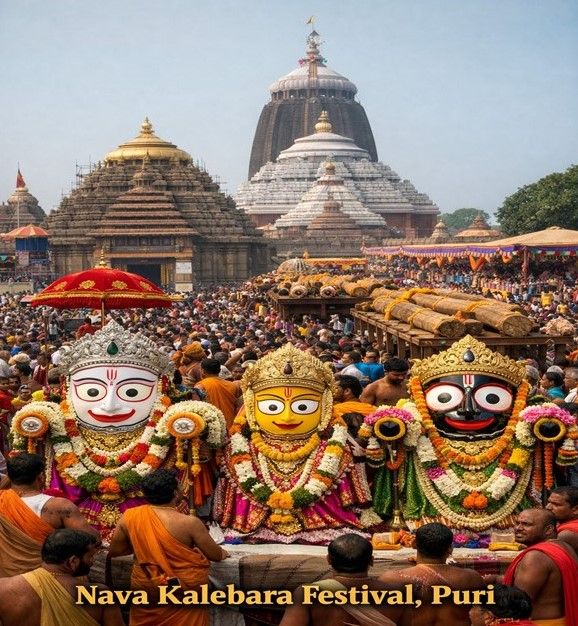
The Nava Kalebara festival of Odisha is one of India’s most extraordinary spiritual traditions, celebrated in the holy city of Puri once every twelve to nineteen years. The term comes from two Oriya words: Naba (new) and Kalebara (body), symbolizing the renewal of the physical forms of Lord Jagannath, Lord Balabhadra, and Goddess Subhadra. This rare ritual embodies the eternal cycle of life, death, and rebirth, making it a deeply revered event for Millions of Devotees Worldwide.
Determining the Festival Year
The timing of Nava Kalebara is based on a unique astronomical calculation. The festival occurs in a year when the month of Asadha (June–July) has two full moons. To balance lunar and solar years, one lunar month is excluded every three years, known as Adhimasaor Mala Masa. This sacred month, also called Purusottama Masa, is considered most auspicious for renewal. In the last century, the festival was observed only seven times in 1863, 1893, 1931, 1950, 1969, 1978, and 1996.
The Sacred Tree Hunt
Once the date is fixed, the Gajapati Maharajah of Puri issues a proclamation to the Vidyapati, Daitas, and learned Brahmins to begin the search for sacred trees. This proclamation is made on the tenth day of the full moon of Chaitra. The Mahapatras receive the Agnya Mala a garland symbolizing divine permission before setting out.
The team, including Daitapatis, Deulakarana, Tudhan, Lenka, and carpenters, travels to the temple of Goddess Mangala at Kakatpur. Here, they await divine guidance in dreams before beginning their search. The chosen trees must be Neem with four branches, located near a burial ground or river, and meeting several other sacred conditions.
Rituals of Transformation
Once identified, the trees are consecrated through the Bana-Yaga ceremony conducted by four Brahmins. The Daitapatis meditate for three days, after which the Vidyapati marks the tree with a golden axe. Carpenters then cut the logs, which are transported in newly built carts pulled by devotees rather than animals.
The logs are placed in Koili Baikunthawithin the temple compound. On Snana Purnima, they are ritually bathed before being moved to the Darughara, where eight Brahmins perform sacred rites. Carpenters carve the new idols, and traditional Chitrakars paint them in their respective colors.
Transfer of the Brahma
The Most Mystical Ritual is the transfer of the Brahma Padarthathe divine essence from the old idols to the new ones. This is performed by the senior-most Pal Mahapatra during the dead of night, blindfolded and with hands covered. The essence is taken from the navel of the old idols and placed in the same position in the new forms. The old images are then buried in the wells of Koili Baikuntha, marking the completion of the sacred transformation.
A Festival of Faith
The Nava Kalebara festival is not merely a ritual but a grand spiritual phenomenon. It attracts millions of devotees from across the globe, making Puri a vibrant hub of faith and devotion. The renewal of the deities symbolizes the eternal truth that while forms may change, the divine essence remains eternal.
This majestic festival stands as a testament to Odisha’s rich spiritual heritage and India’s timeless traditions, blending astronomy, ritual, and deep devotion into one of the most extraordinary celebrations of faith.